
WSPR (pronounced “whisper”) is an acronym for Weak Signal Propagation Reporter. It is a protocol, implemented in a computer program, used for weak-signal radio communication between amateur radio operators. The protocol was designed, and a program written initially, by Joe Taylor, K1JT. The software code is now open source and is developed by a small team. The program is designed for sending and receiving low-power transmissions to test propagation paths on the MF and HF bands.
WSPR implements a protocol designed for probing potential propagation paths with low-power transmissions. Transmissions carry a station’s callsign, Maidenhead grid locator, and transmitter power in dBm. The program can decode signals with a signal-to-noise ratio as low as −28 dB in a 2500 Hz bandwidth. Stations with internet access can automatically upload their reception reports to a central database called WSPRnet, which includes a mapping facility.
wikipedia (amateur radio)
WSPR is a great mode to use for testing the ‘reach’ of your station. Signals are sent via computer, connected to the radio, at low power (10 watts or less) … which are then received by remote stations and recorded to a central database of reports.
I’ve used WSPR to test my configuration here in North Texas and was REALLY surprised at the distances that the signals from my radio carry – especially given my HOA-restricted marginal End-Fed Half Wave (EFHW) antenna run around my 6′ wooden fence. As you can see from the map below, my low power 10 watt ‘beacons’ have been heard at remarkable distances. The data below was collected over a single 24 hour period in April 2023 – shortly after I setup my station.
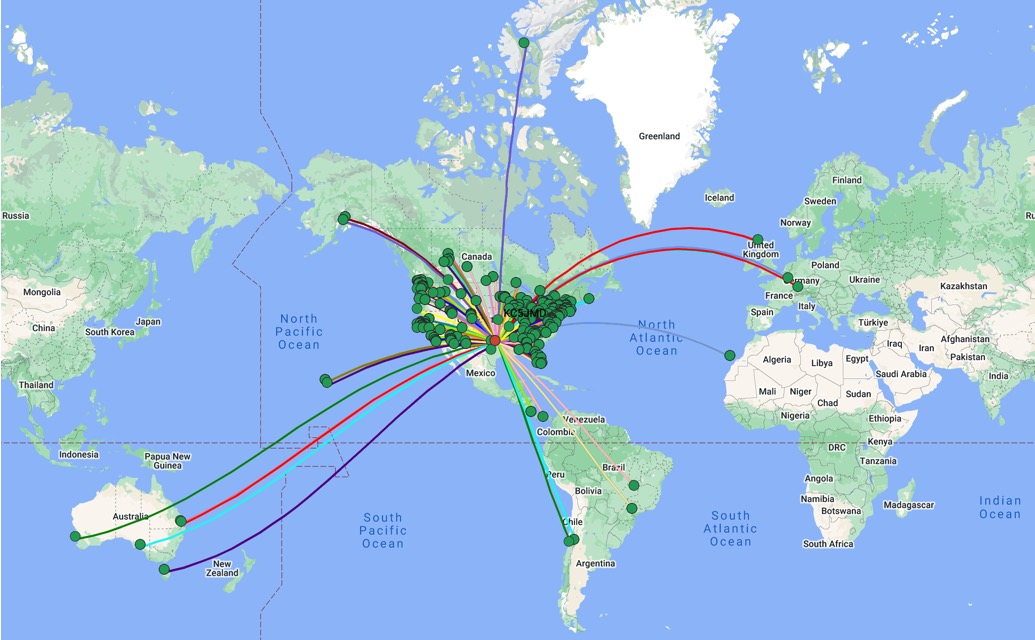
I have a great deal more to learn about antenna optimization and tuning, so will continue to run this test and collect the propagation data as I make changes to my configuration. Check back for updates over the coming months.